The fastest-looking weld is not always the fastest finished job. A shop making repeat batches of accurately cut stainless-steel parts faces a different decision from a repairer working on a bracket that arrived bent, rusty and missing a corner.
Laser and TIG welding can both produce sound joints. Their differences become useful when we ask what the actual workpiece, operator and workshop require. This is a comparison of the processes—not a claim that we have personally tested either machine.
Start with the heat source
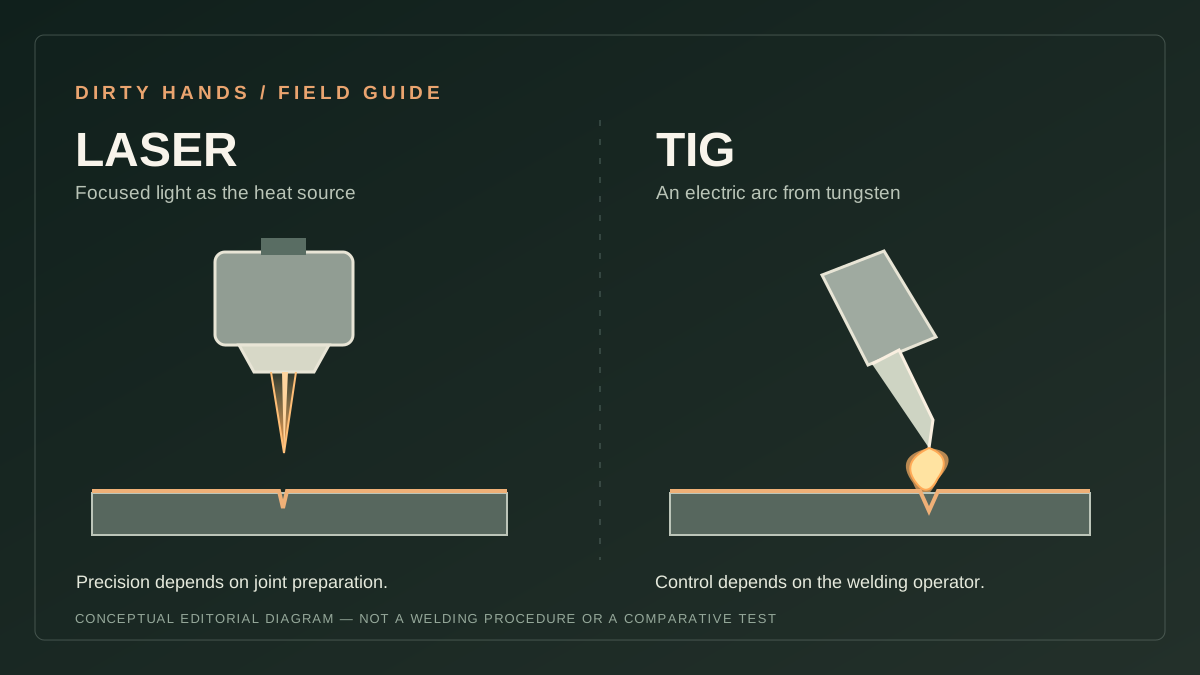
TIG, also called gas tungsten arc welding (GTAW), creates an electric arc between a non-consumable tungsten electrode and the workpiece. Shielding gas protects the weld pool. The welder or an automated feeder can add filler separately when the joint needs it. On a manual job, the person at the torch can see the pool and adjust current, travel and filler in response to what the metal does.
Laser welding concentrates light into a small area. Industrial laser systems range from enclosed automated cells to handheld machines. Depending on the joint and settings, they can make narrow welds with relatively low total heat input and fast travel. Some joints are welded without filler; other applications need wire or a hybrid laser–arc process. The word “laser” alone does not tell you the penetration, quality or suitability of a particular weld.
TWI documents laser welding's narrow, deep-weld capability and productivity advantages under suitable conditions. Its TIG guidance explains why control of the arc, pool and filler remains useful for precise manual work. TWI laser welding · TWI TIG process
The comparison a workshop can actually use
| The question | Laser welding | TIG welding |
|---|---|---|
| How consistent must the joint be? | A small focused spot makes many laser setups sensitive to gaps and misalignment; fixtures and preparation matter. | The operator can respond to some variation with pool and filler control, within the approved procedure. |
| What happens to heat and distortion? | A suitable fast, narrow process can reduce total heat input and distortion. | Fine current control is available, but slower travel can put more heat into the part. |
| Is filler needed? | Some joints are autogenous; wire-fed and hybrid options also exist. | Filler can be added independently when the joint or specification requires it. |
| How is the work performed? | Automated cells or handheld equipment; both demand properly trained people. | Manual or mechanised equipment; manual work relies heavily on torch, current and filler coordination. |
| What does the shop need? | Laser-rated risk controls, beam management, suitable fixtures and often significant integration work. | Power source, torch, shielding-gas system, consumables and conventional welding safety controls. |
| What establishes weld quality? | A suitable procedure and inspection for the actual application. | The same principle: appropriate procedure and inspection for the actual application. |
These are process tendencies, not performance guarantees. Material, thickness, joint design, fit-up, machine and approved welding procedure can change the result.
The hidden issue: how the parts arrive at the bench
A demonstration normally starts with clean samples that fit. A repair may not.
TWI explains that a tightly focused laser spot has limited tolerance to joint gaps compared with conventional arc welding, particularly for autogenous butt joints. Clamping, seam tracking, beam movement and filler wire can improve tolerance, but each has consequences for process setup and sometimes speed. TWI discusses gaps of less than 10% of material thickness as a typical condition for some autogenous butt-joint cases—not a universal rule for every modern laser machine.
Before comparing travel speeds, ask who will cut, clean, position and clamp the parts. If a shop must remake every joint to fit the process, faster welding may not mean faster production.
Original technical explanation: TWI, tolerance of laser welding to joint fit-up
Heat input: important, but not the whole story
A narrow laser weld can leave less thermal distortion on suitable parts. That can matter when a thin panel must remain flat or a finished assembly must keep its dimensions. But “laser means no distortion” would be an irresponsible promise: actual results depend on the joint and operating conditions.
TIG offers a different kind of precision. With appropriate equipment the welder can change current while moving, add filler when needed and manage the pool on a short, intricate joint. It can be slow on longer seams and requires practice. Neither method compensates for an unsuitable joint design or poorly controlled procedure.
Safety: a handheld laser is not simply another TIG torch
A handheld laser welder may look compact, but the equipment commonly uses a Class 4 laser. Direct and reflected radiation can cause serious eye or skin injury; some industrial laser light is invisible. Ordinary TIG helmets and standard safety glasses are not sufficient laser-beam protection.
American Welding Society guidance describes laser-controlled areas, appropriate barriers and interlocks, wavelength-specific eye and face protection, trained operators, a laser safety programme and control of fumes. The exact legal and technical requirements must be established for the machine and jurisdiction, not guessed from an online video. TIG has its own serious hazards too, including arc radiation, electric shock, fumes, hot metal and fire.
A price comparison that excludes the safe laser workspace is incomplete. If a supplier cannot explain beam containment, reflected-beam risks, training and safety documentation, the purchasing discussion is not finished.
AWS: Handheld Laser Welding Safety, January 2025 · AWS: Getting a Grip on Handheld Laser Safety, January 2026
What will the finished job cost?
The price on the front of the power source is only one line of the calculation. A meaningful workshop comparison considers:
- preparation and clamping time per part;
- welding time and rework or finishing time;
- shielding gas, filler and other consumables;
- operator training and procedure qualification;
- laser enclosure, interlocks, extraction and maintenance where applicable;
- inspection, rejected parts and required traceability;
- the number of similar jobs expected each month.
Ask for a quotation on the whole working setup and a documented trial on your actual joint, with the acceptance criteria agreed before the trial. Do not transfer a speed claim from a showroom sample directly to a repair job or a code-governed structure. We are not publishing universal euro prices or “three-times-faster” claims because those would require a defined machine, part and test method.
Questions to take to a supplier or welding engineer
- Which material grades, thicknesses and joint types have you actually qualified or demonstrated?
- What fit-up, clamping and surface condition does the process require?
- How is penetration confirmed—and what inspection does this application require?
- Is filler wire needed for this joint, and what changes when it is added?
- What enclosure, interlocks, eyewear, extraction and training are included in the proposal?
- Can we compare complete cycle time and accepted parts on the same production job?
What DIRTY HANDS takes from this
A new machine can change how a craft is practised. It does not remove the need to understand the material, recognise a poor joint, check the result and take responsibility for the work.
In a disciplined batch process, laser welding may create opportunities that a shop should investigate. On varied one-off repairs, the control and versatility of TIG remain relevant. The decision starts with the work—not the technology on the brochure.
References and original documents
This is an independent explanation, not a hands-on test or endorsement.
- TWI — Laser Welding Services — Laser welding mechanisms, typical heat-input and productivity characteristics, and material context.
- TWI — TIG or GTA Welding, Job Knowledge 006 — TIG fundamentals, shielding, manual and mechanised use, and limitations of deposition rate.
- TWI — Laser Welding Tolerance to Joint Fit-Up — Joint-gap limitations and the effects of clamping, filler wire, beam movement and hybrid processes.
- American Welding Society — Handheld Laser Welding Safety (January 2025) — Class 4 laser hazards, reflected beams, controls, protective equipment and laser-controlled work areas.
- American Welding Society — Getting a Grip on Handheld Laser Safety (January 2026) — Practical considerations for personnel protection, engineering controls, training and airborne contaminants.
- Miller Electric — Guide to TIG Welding Basics — Manufacturer explanation of TIG equipment, amperage control, shielding, filler and working with different materials.
This is an editorial process comparison, not a welding procedure, a machine test or a substitute for qualification and risk assessment. Handheld Class 4 lasers require a properly controlled, assessed work area and protection matched to the equipment; standard TIG eye protection alone is not adequate for laser-beam hazards.